Pages

Showing posts with label Young Writers. Show all posts

Saturday, August 1, 2026

SELI Young Writers in Primary School

While most of our SELI Young Writers clubs are located in junior secondary schools, we have been glad to see clubs in a few primary schools as well. The earlier the better, especially because English is a second language for students in Sierra Leone.

SDA Primary School in Samuel Town is one of these schools. The club welcomes members from class three to class six, and has been very productive. 

Here is a piece written this year by Marie Kanu, in class six. I know you’ll be as pleased for her as I was when I read it.

My First Topic


When I wrote my first topic in the Seli River Writing Project, it was not fine because I was not writing fine. I was just writing sm…sm…sm to fill up the paper. 

When I came for the teacher editing step my teacher, Ms Coker, said, “Marie, now read your work.” 

I was not able to read the words. My teacher said, “Marie, because you cannot read your work, I will not be able to edit it. Mind you spell words by their letter sounds, syllables and digraphs. You have just made one set of two letters and filled the paper with sm…sm…sm and so on. Now, take another piece of paper and try to write again what you want to say.”

I took another sheet of paper. I tried to write again and went through the process before coming to teacher editing again. This time, I was able to write better than the first one and I read it to the teacher and we did teacher editing. 

After that, my teacher sang a Krio song about me, saying,


“Marie dɔn kɔmɔt pan sm…sm…sm!”


She danced with the Krio song. We were all happy and I went to do the process again. I felt good because I was able to write a bit. 

I really appreciate the Seli River Writing Project! I thank God for writing better English now.


Sunday, January 11, 2026

Learn English Through Krio


I hope you can see this photo well, because a very special, unique activity is going on in this SELI Young Writers club in northern Sierra Leone at Dankawalie Secondary School. 

All SELI Young Writers club meetings open with a 10-15 minute mini-lesson that precedes writing.  As one option for this mini-lesson, SELI donates copies of the workbook, Learn English Through Krio (formerly called The SELI Wordbook), in which one page at a time teachers can help students distinguish the form, use and meaning of an English word, from its cognate in Krio. It needs to be said that it is unusual at any level in Sierra Leone schools for teachers to clarify the differences between Krio and English.


The special thing we are seeing in this photo is a DSS club senior-secondary experienced writer using this workbook to conduct a mini-lesson for junior-secondary newcomers to the club. All of these students speak Kuranko as their primary language. They have learned Krio (informally) and English (formally) in school. A fellow student—an older brother, we might call him—can easily remember how confusing it was for him to distinguish Krio from English when he was their age, making him ideal for delivering this mini-lesson. 

Well done, Dankawalie Secondary School!

Saturday, January 10, 2026

Thank you!


 In wishing everyone a happy new year, I want especially to thank a very special anonymous donor for supporting SELI’s writing programs last month. Thank you so much for your generosity! That was a boost we needed.  

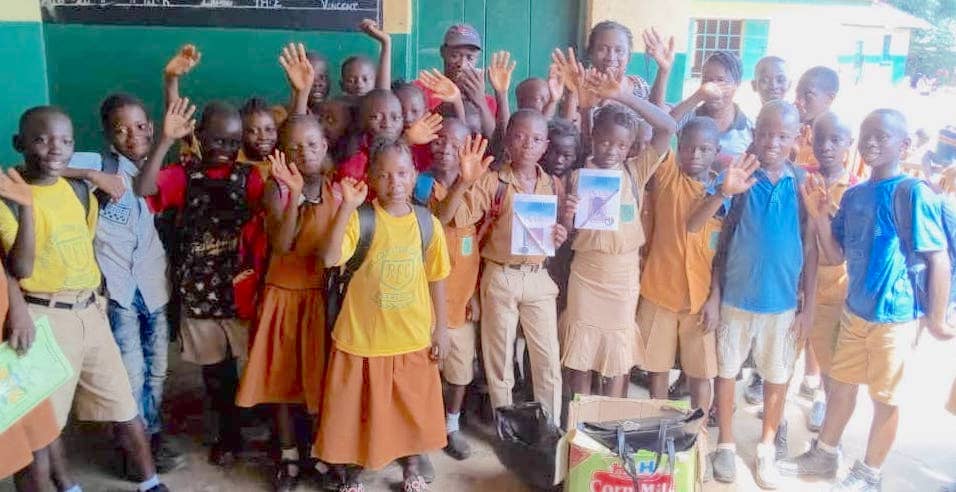
You see here some of the students in a SELI Young Writers club at the SDA Primary School in Samuel Town, on the rural Freetown Peninsula in Sierra Leone. I have just had a wonderful time typing up forty-two final drafts of the writing pieces these class 5 and 6 students have completed, and they tell me they have more to send me!

I will be returning these final copies along with the 3-4 revised drafts and conferencing notes attached to each one. Each person in the club is trying to complete at least five writing pieces to earn a club booklet of their work (and, as a side benefit, be better prepared for exams and promotions facing them at the end of the school year 👍.) 

I do enjoy reading their work. All of them are putting true personal experiences on paper for the first time. The emotional incidences playing in their heads as they write, matter. What will the effect be on the reader if they put this first, or if they don’t mention that? Every writer reading this knows that such questions don't go away as you advance; they stay with you and make you a better writer. 

For giving these children the chance to learn how to write, we all thank you! 👏


Friday, September 29, 2023

Whose Role Model are You?


In choosing what we want to do in life, our first criterion might not be gaining the admiration of those who are younger than we are. Funny, though—it happens. 

Sometimes we just take part in an activity we enjoy. We work hard at it when we see that it benefits us. That's what Damba F. Daramy did. Here she is gaining recognition for working hard at expressing herself in writing in the SELI Young Writers club at Dankawalie Secondary School over a period of two or more years. She is receiving a printed booklet of all the writing she worked so hard to produce.

And by doing so, Damba has become a role model. She has inspired the young newcomer to the school, also captured in this photo, to follow in her footsteps. We look forward to seeing this young girl also before the school assembly in a couple of years, being recognized for her achievement as a writer. And being someone else's role model, too!


Tuesday, May 16, 2023

Damba's First Day

Everyone's first day in a new place stands out in their memories, and is distinctive from everyone else's.

Damba will receive a "My Life" book this term, containing all the experiences she has written about in her SELI Young Writers process-writing club at Dankawalie Secondary School in the past two years. 

One topic she chose to write about was how she came to join the club. I thought you'd like to read what she wrote:

First Day at SELI

 by Damba


One day when we were in the assembly, Mr K called the SELI members Abu, Fatmata and Alusine. 

I decided to go with them. When they were writing their experiences, I did not know what to do. I stood by the door and watched them. They were taking paper and pens to write. When Mr K called me, he said, “Why are you standing without writing?”

I said I did not know how to write a story. He said, “Ok, come here. Let me show you how to write a story.” He explained the steps that I must undertake when writing. 

The first story that I wrote about was my aunty’s death in Freetown. 

I liked the story about my aunty. When they came with the typed story, Mr K told me to read it in the assembly. I was afraid. My friends told me not to be afraid when reading it. By the end of my story, I started crying because I lost my aunty whom I loved best.

Since that day, I liked SELI and story writing is my favourite activity. My parents, too, liked the story I wrote of my aunty.


We praise this school for giving students many opportunities to read their own writing aloud to others, such as reading it aloud in assembly and taking it home to share with their parents. 

Tuesday, February 8, 2022

"The Club Plays a Great Role"

 I am getting messages from schools whose SELI Young Writers process-writing clubs were suspended when COVID-19 hit two years ago, telling me, "We really need this club back!"

When I ask why, they say "It helps the students improve greatly in their essay writing, and that plays a great role in their national exams." Hooray!

Of course, I am glad when school heads recognize the effect of what goes on in SELI Young Writers clubs. What needs to happen now is for school heads and English Language teachers to realize that the improvement they are seeing did not come about specifically because of the SELI Young Writers club, but because the club's writing instruction is centered around process writing. And it's all self-motivated writing. We do no testing at all.

I'm also pleased to hear school heads say that the club strengthens their teachers' written and oral communication skills. All good!

Now all we need is funding to make it happen! Every $10 counts!

Monday, January 24, 2022

Read Your Work Aloud in Sussex

Two teachers from Sussex village on the Freetown Peninsula run an after-school SELI Young Writers club whose membership draws on enrollment from several junior secondary schools in the area. 

Moses Gbondo and Ballah Kamara have been running the club for several years at the Abundant Grace International School, which this year has a larger facility—meaning more space to spread out during COVID times. Both teachers are good at monitoring simultaneous conferencing groups where students read their work aloud for peer feedback to improve their second drafts. In the background of the photo, you can see other students drafting or revising their work.

Sunday, January 23, 2022

"Give at Checkout"

Thank you, thank you all! All you wonderful anonymous donors who have given to the Sentinel English Language Institute to help young students in Sierra Leone to succeed in school and to become writers in the future, by donating $1 every time you make an online purchase through PayPal

Every $1 contribution to our educational charity counts! It has made a big difference in what we are able to provide for the writing clubs we support. If you are comfortable doing so, send me an email at jackie@seli.co letting me know that you've helped, so I can thank you (all the "gives at checkout" are anonymous).

If you use PayPal, I encourage you to look for the chance to set the Sentinel English Language Institute as your favorite charity, so that every purchase you make helps another student in Sierra Leone learn to write when it counts!

Saturday, January 15, 2022

Publishing In Action


Just before the break between first and second terms in December, the SELI Young Writers Club at SDA Primary School in Samuel Town on the Freetown Peninsula submitted twenty final drafts for me to look through and type.

I have returned them reminding the facilitators to allow every student with a newly typed final draft the time to "publish" their work by reading it aloud to the club. Here, Kadiatu is doing just that, with her teacher, Ms Princess Coker, in the background. 

I know Kadiatu feels very proud! All the students are writing true personal experience narratives in an additional language—English—which is the only language in which they are gaining literacy. Because the club is a process-writing workshop, they are developing reading, writing, listening and speaking skills in English all at the same time. 

I provided two typed copies of the final draft for Kadiatu. One is in her hands, stapled to the previous 3-5 drafts of the piece, and the other is in the hands of the facilitator who is following along silently while Kadiatu reads aloud in her most expressive voice, in case she needs help. This is about the 6th-8th time Kadiatu has read through her narrative. When she is finished, she will return the stapled drafts to her manila folder, and take the extra typed draft home to show her family. 

I hope they will ask her to read it aloud for them.

Friday, April 23, 2021

SELI Young Writers are writing again!

Here we are in the library at Dankawalie Secondary School in the northeastern Falaba District of Sierra Leone.


After a year's COVID-19 break, this school's SELI Young Writers club resumed this week, on the first day of the third term, with a full house. In addition, the library where the club meets today is much brighter thanks to Lasiray Energy and Communications which now offers solar power to subscribers throughout Dankawalie town.

Any of these students who attends this student-centered, workshop-like club regularly for 1-2 years will develop five personal experience essays through a number of revisions and editing, and in the process take such strides in their writing, reading, listening and speaking skills in English that their performance on their BECE public examination will be greatly improved.

Many thanks to the school's administration and to the club's facilitators, Mr. B.M. Kargbo and Mr. Kalie Kamara, as well as to the donors who make these clubs possible. 


Wednesday, September 9, 2020

In the Time of COVID 2

 This week, I sent this notice to the principals of schools where SELI maintains Young Writers clubs under the Seli River Writing Project:

I am sorry to say that because of the current COVID19 situation, SELI will be suspending Young Writers clubs for the 2020-2021 school year. I have hesitated to take this decision because every year it is the children who are at the highest risk of failing that our clubs embrace.


High-risk students benefit greatly from good content conferencing on their true personal experiences, which is best done around a table in groups of 4-6 with a teacher present. Everyone participates: children learn English from reading their work aloud, asking good questions, reflecting and explaining. People at the table talk quietly so the rest of the class can draft and revise.


Members also benefit from peer editing, where they sit closely with another member and discuss spelling, punctuation and verb tenses in both of their pieces. In teacher editing, they read their work aloud as they sit next to a teacher. The teacher listens to how the authors read to know whether they understand where sentences end, or whether someone is speaking, and then ask authors what kind of punctuation they need.


This proximity that is such a plus in our club meetings becomes a minus when social distancing is the rule. There are other reasons that we need to step away from club meetings during the COVID period. Moving about the room to access shared writing supplies or to go on to the next writing stage, helps club members take ownership over both their writing and their progress, but it, too, obstructs social distancing. Even the fact that we meet before or after school means that our students may not be protected by the same level of COVID precaution that is enforced by the school during its regular school hours. The health and safety of our children is paramount.


We fully expect to restart the SELI Young Writers program for the 2021-2022 school year in all interested schools. I urge you, in the meantime, to develop a teachers’ community of process-writing practitioners in your school using your Young Writers club teachers as advisors, so that this valuable method of teaching writing will gain its deserved place in your regular school classrooms. 

In the Time of COVID 1


Twelve members of SELI's Young Writers clubs are about to receive "My Life" booklets like the ones pictured here from a previous year. To state that more clearly, before schools closed on March 31st, 2020, to protect students and staff from the pandemic, twelve club members had completed five final drafts, qualifying them for a printed booklet of their work. 

Some of the recipients are from these schools in the Koinadugu and Falaba Districts: Dankawalie Secondary School, Dankawalie (4); Kabala Secondary School JSS, Kabala (1); and Movement of Faith Secondary School, Yiraia (3). 

Other recipients are from these schools in the Western Rural Area: REC Primary, Bassa Town (1); Heaven Homes, Joe Town (2); and Seventh Day Adventist Primary School, Samuel Town (1). 

We are delighted that Kalie A. Kamara, one of the club facilitators from Dankawaliehas been writing as well, and will also be receiving a booklet. Let's have more facilitators writing!

Saturday, January 25, 2020

What Primary School "Young Writers" Write About


Teachers usually prepare upper primary school students in Sierra Leone for the composition component of their Class Six public examination by having them write descriptive essays on topics such as "My Family" and "My Pet."


A few years ago, SELI extended its Young Writers program to rural primary schools. In these ESL process-writing clubs, students in Class 4 to 6 learn to write narrative essays by coming up with a list of their own true personal experience topics, and choosing which one they would like to write on next. They get help with revision by reading their first drafts aloud to their peers and teachers.

A little analysis shows us that the pieces of writing Class 4 to 6 students have produced in Young Writers clubs over the past several years fall into five general content categories, listed here. 

Perceived injustice (theft, abuse, deprivation of food or schooling and false accusation, either of self or elder sibling or parent). Seeking retaliation, recompense, or sympathy by appealing to relatives or neighbours, crying loudly, or running away. Boys choose this topic more often than girls.
Loss (or life-threatening injury or illness) of a family member or close friend. Nearly all of them write about death. They lack the age-appropriate writing skills to describe how it makes them feel (apart from saying, “I cried and cried.”) or what the loss means for them (ways in which this person had provided love, humor, security, tuition, protection against harm, food, shelter, and so on).
Friendship. The friends who are willing to accompany them to carry out an assigned task, and the support a best friend gives when they are in trouble.
Injury, often while carrying out tasks for adults. Includes how to travel to a health centre and pay for medical treatment. They all mention having to miss school but do not describe what that means to them. Their accidents can be categorized in this way:
vehicle (hit by an okada [motorcycle taxi] or car)
domestic (in kitchen, at stream, at market, house fire, severe flogging)
play (while playing football, running)
animal frights or bites (by a snake, dog, scorpion, monkey)
farm (fall from tree, cutlass injury, falling branches, flooding)
Venturing away from home. Whether they will find a friend there, be treated well, and succeed.
holiday period with aunt/uncle
experience at school, farm, beach
travel to another town/city
Being underestimated is a common underlying theme—rarely a writing topic in itself. Understanding the meanings implied in what adults actually say, or not being allowed to explain their observations because they are children. 

Forgiving a remorseful wrongdoer is another common underlying theme. The author will end a story about the pursuit of a thief with the author’s elders forgiving the person and giving their reason. Sometimes when the perpetrator is a schoolmate, the piece ends with the author doing the forgiving with a similar reason.
Perhaps you would agree that in terms of writing, primary schools might be under-challenging their pre-teen students!

Wednesday, November 6, 2019

"My Life" Books for 2019

In 2019 SELI made twenty-one "My Life" books for Young Writers club members. That is, twenty-one students in the nine clubs completed a minimum of five final drafts of personal experiences, doing all the stages of the writing process within the club meetings: rehearsal, drafting, content conferencing, revising, editing and publishing.

The experiences are published as chapters in the books. The authors also had their photos taken and wrote dedications and "about the author" paragraphs to include. Here are the four members who earned "My Life" books in Heaven Homes Christian Academy in Joe Town, near Waterloo, posing with their teachers, Mr. A.P. Kamara and Mr. A. Kallon, and other members of the club who are on the way to finishing their books this academic year.

 The two members who earned books in R.E.C. Primary School, Bassa Town (near Waterloo) gather with club members and one of their teachers, Ms. M. Kposowa, and their headteacher, Mrs. Yearie Kamara.

At Kabala Secondary School Junior, "My Life" booklets were presented at assembly by the principal, Mr. James S. Conteh.


Friday, September 13, 2019

Read All About It!

Young Voices, no. 7.1, is out! Click, and settle down for a good read.
You'll learn all about what students in SELI's Young Writers clubs have written in their twice-weekly writing workshops. The members of our nine writing clubs all have copies, and are reading them, too. This girl is in REC Primary School, Bassa Town (near Waterloo).

Our children are learning to express themselves in English, which is not easy for them. Your comments, or feedback, are welcome.

Tuesday, April 23, 2019

My First Day at SELI

The staff and students in one of the rural junior secondary schools where we have an ESL Young Writers club, usually refer to it as "SELI." I am typing their final drafts today, and just had to share one that made me smile!

                                  
                       My First Day at SELI
                               by Alhaji K.

On Monday, 2nd October, 2018, my friend Yusufu and I were coming to our school. I heard him say, “Today is SELI. I have two final drafts.”
I said, “I, myself, will go to SELI today.” SELI is the writing club of the Sentinel English Language Institute. We went to the library. I sat down and I watched my schoolmates to know how they do it. 
My friend Yusufu came. He said, “Alhaji, go and take some A4 paper.” I went but when I was about to take it, I was afraid because I saw Mr K. and Mr B.M.K. I returned and sat down. I was confused at that time. My friend David was looking at me. He came to me and he said, “Don’t fear anything. Everything here belongs to us, the SELI students.”
I went and took the A4 paper. I first wrote my childhood story. 
At that time I was in JSS II, the first term. From that time I have become one of the regular students of SELI.

Saturday, March 23, 2019

Writing: Your Own Words, or Someone Else's?

I spent time in the Young Writers content conferencing group at the R.E.C. Primary School in Bassa Town yesterday with Class 4, 5 and 6 boys and girls. You see here one of the facilitators enthusiastically introducing me to the new students.

Halfway through I glanced up at the chalkboard. It laid out in detail one of their lessons that day on how to write a composition. The lesson included copying (to memorize) a sample essay on one of the descriptive topics likely to appear on their public exam at the end of Class 6. Is it ironic or illogical or disjointed or what, that we carried on as if the two writing activities were completely unrelated? The question is, what constitutes writing? Is it writing your own words, or someone else's?

The success of a Young Writers club can be attributed to the staff: the teachers and headmistress who encourage and guide the students—and in this school even sometimes hand out sweets—until they finish their first final drafts, earning "I Am an Author" buttons to wear on their uniforms. We find that often those accomplishments give students the confidence they need to continue writing until they build their My Life booklets all by themselves.

Tuesday, December 11, 2018

Keep Those Kids Talking!

We made contact with seven SELI Young Writers clubs on our trip following the Seli River to Koinadugu and Karene Districts last week. All the facilitators were present in our training in May, 2018 and three of the clubs (in Lunsar, Yiraia and Gbenikoro) are new this year.

One common thread wound through all our discussions: facilitators can't minimize content conferences. If we're going to make second language learning happen, we have to keep those kids negotiating issues orally! We checked first that the topics they are choosing to write from are their own true personal experiences. Once that was settled, we put all our gusto into widening the space and time given to reading work aloud to peers, into listening to those stories read aloud and asking good content questions about them, into listening to the reply and amending the question, and so on.

I am finding that facilitators in established clubs may not even be aware that content conferencing has been a make-or-break factor in their success. We found one club's formerly lively content conferences have devolved into one-on-ones with a teacher, and students now refer to them as "correcting" sessions. Small wonder that the meeting lacked the vibrancy and productivity we have seen there before.

Another place in the writing process where students MUST talk is during teacher editing. If they are not reading their work aloud as you point out errors, how can you distinguish between students who left out full stops or commas because they have no sentence sense, and those who expressively pause or drop their voices where the punctuation should be, and simply need to be reminded?  How can you make paragraphing come from their own instincts if they are not switching gears orally as they read?

We did see inspiring work being done, and we're glad now that WhatsApp helps us keep in contact even with schools located out of mobile coverage areas.

Thursday, June 14, 2018

Young Voices 6.2


Enjoy reading the latest issue (6.2) of the newsletter of SELI's Young Writers clubs, Young Voices. All the children write about their true personal experiences, so you get an idea of what their lives are like as you read. All live in rural areas, some close to the capital city and some very far from it.

We welcome your comments!

Sunday, May 27, 2018

Leading Young Writers Workshop 6

This is us, LYW6, all seventeen of us. We have spent the last three days together at SELI in Tengbeh Town, in Freetown, working on what process writing is, and how to use it in after-school SELI Young Writers clubs as well as in writing classes. You see us gathered here just before certificates were awarded.

There are teachers here sent by nine schools included in the Seli River Writing Project—schools located in Joe Town near Waterloo, Goderich, Lunsar, Kabala, Gbenikoro, Yiraia and Dankawalie.
For some, this was a refresher course; for others, it was a training for club facilitators needed to replace teachers who have moved on. And for three schools, it was an initial training to open a new club. It was marvelous having the experienced facilitators present! They shared their knowledge and learned new tricks.

We spent the three days working on writing theory, how to run clubs, English grammar and usage, and the elements of process writing that can be introduced one-by-one into writing classes without much fuss.

Part of each day was conducted like a process writing workshop, so the teachers could experience themselves what they would be asking their students to do. For our mini lessons each day, we used The SELI Wordbook. In the photo, you see a content conferencing group, listening to one person read his personal experience aloud as the others write questions they plan to ask him when he is finished.

Thank you to the SELI donors who made this training workshop possible, and to this wonderful group of teachers and their schools for appreciating the importance of writing!